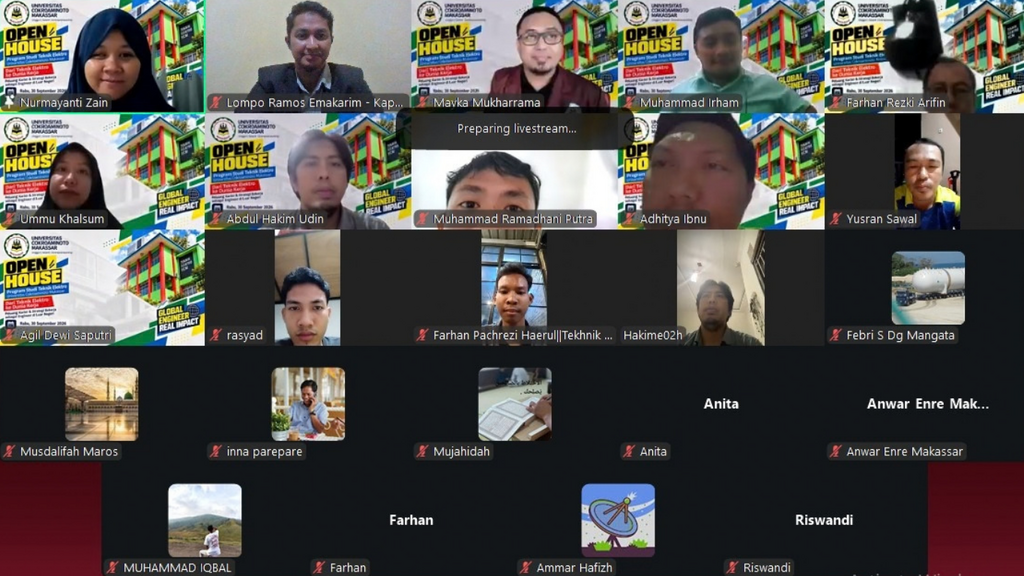
MAKASSAR – The Electrical Engineering Study Program at Universitas Cokroaminoto Makassar (UCM) provided a clear perspective on the professional world and career opportunities for engineers during an open house titled “From Electrical Engineering to the Professional World: Career Opportunities & Strategies for Working as an Engineer Abroad,” held online on Wednesday (September 30, 2026). The event featured academics and practitioners from various sectors, demonstrating how Electrical Engineering competencies are applied in the workplace—ranging from construction and telecommunications to the international oil and gas industry.
Lompo Ramos Emakarim, S.T., M.T., Head of the UCM Electrical Engineering Study Program, explained that the program equips graduates with competencies relevant to the demands of the professional world. The curriculum strengthens expertise in telematics and networking by integrating telecommunications, computing, and informatics. This includes preparation for CCNA certification and English language training, with a target TOEFL score of 550. Graduates are guided to be competitive both nationally and internationally, capable of seizing career opportunities across various fields related to Electrical Engineering.
Dr. Ir. Marliana S. Palad, M.Si., Dean of the UCM Faculty of Engineering and Agricultural Technology, emphasized that the scope of Electrical Engineering is expanding in line with the growing demand for electrical systems, automation, the Internet of Things (IoT), and artificial intelligence. Consequently, it is not enough for graduates to possess only academic knowledge; they must also be adaptable, skilled in problem-solving, effective at communication and teamwork, possess integrity, and stay abreast of technological advancements to contribute meaningfully at both national and international levels.
Insights into career opportunities within the construction sector were shared by Ummu Kalsum, S.T., M.T.—a lecturer and practitioner with six years of experience in the construction industry. Drawing on his experience in construction management and planning, he explained that Electrical Engineering graduates can fill various roles, such as drafters, quantity surveyors, quality control specialists, estimators, and construction managers. Field experience, the ability to interpret technical drawings and electrical installations, material oversight, and ensuring that work aligns with project approvals are all essential components of an engineer's competency.
Muh. Irham, M., S.ST., M.T.—a lecturer in telecommunications with over 10 years of industry experience—provided an overview of technological evolution leading up to the 5G era, as well as roles in network optimization, monitoring, and service quality enhancement. He emphasized that engineers require not only technical proficiency but also data-handling skills. Mastery of Microsoft Excel, database management, traffic trend analysis, and report writing are crucial for supporting daily operations and decision-making within the telecommunications sector.
International career opportunities were discussed by Mayka Mukharrama, an Electrical Engineering student at UCM who has spent 11 years working in the oil and gas industry in Kuwait. Her experience offered a firsthand look at an engineer’s journey in building a career within a global work environment. She stressed that working abroad is not merely about securing a job in another country; it demands specific competencies, strong communication skills, character, a sense of responsibility, consistency, and the ability to adapt to diverse professional settings.
Mayka also encouraged students to begin preparing for their careers while still in university by setting five-year goals, identifying two or three priority skills, developing projects to demonstrate competence, seeking mentors, honing English language proficiency, building a portfolio, and cultivating a professional network. She noted that opportunities may arise before one feels fully prepared, making both thorough preparation and the courage to seize such chances vital to one’s career trajectory.
Meanwhile, UCM Electrical Engineering lecturer Abdul Hakim Udin, S.T., M.T. ...who is also a telecommunications leader with 19 years of experience in network deployment, transport networks, and nationwide telecommunications infrastructure, highlighted the wide range of career options available to Electrical Engineering graduates in the telecommunications industry. Beyond roles as network engineers, graduates can pursue careers in data analysis, project engineering, network development, planning, and project management. He further explained that large-scale network development requires a diverse skill set—encompassing planning, capacity analysis, network design, and implementation, all the way through to operations and maintenance.
The diverse experiences shared by these practitioners demonstrate that an engineer’s journey does not end with the attainment of a bachelor’s degree. The professional world requires graduates capable of applying their knowledge, building experience, mastering technical skills, processing data, communicating effectively, working within teams, and adapting to technological advancements and the evolving needs of the industry.
Through this Open House, the Electrical Engineering program at UCM not only introduces its curriculum but also provides a concrete illustration of how Electrical Engineering knowledge is applied in the professional sphere. The participation of both academics and practitioners from various fields further highlights that competencies in Electrical Engineering can open up a wide range of career paths—from construction projects and telecommunications networks to professional opportunities within international industries.
